

There are few buttons on a busy Monday morning more cheerful than “Continue with Google.”
It is a friendly button. A polite button. A button that says, “relax, this will take a second, you don’t need to lift a finger.” Nobody looks at it and thinks, excellent, another weak link to our internal systems, splashed in a big name brand.
And yet here we are.
On April 19, 2026, Vercel disclosed a security incident involving unauthorized access to certain internal systems. By the time its bulletin was updated, the company said the incident originated with a compromise of Context.ai, a third-party AI tool used by a Vercel employee. The attacker then used that access to take over the employee’s Vercel Google Workspace account, which in turn enabled access to some Vercel environments and to environment variables that were not marked “sensitive.” Vercel said values marked sensitive are protected in a way that prevents them from being read, and that it had no evidence those sensitive values were accessed. It also said a limited subset of customers was impacted and that affected customers were contacted directly.
That is a very modern breach story.
No need for a movie-style hooded hacker exploits, or some wildly exotic chain that only three researchers and one exhausted incident responder will ever fully understand. This was just a compromised third-party AI service, a connected identity path, and a piece of organizational trust doing what trust does best when it is left unsupervised: extending itself farther than anyone intended.
The temptation, especially online, will be to flatten this into a lazy headline about AI being dangerous. That is not quite right. AI is in this story, yes, but mostly as the fashionable wrapper around a much older problem, too much trust concentrated in third-party integrations, too little discipline around app permissions, and not enough respect for the fact that an OAuth grant is not a convenience feature. It is an access decision that, if ignored, becomes an attack point.
That is the part worth sitting with.
The breach did not start where most people would look
Vercel’s public account is unusually useful because it tells you where the first real domino stood. The incident originated with Context.ai, and Vercel said the wider compromise involved the third-party AI tool’s Google Workspace OAuth app, potentially affecting hundreds of users across many organizations. Vercel even published the OAuth app’s client ID and recommended that Google Workspace administrators and Google account owners check their environments for it immediately.
That detail matters because it moves the conversation away from the usual “Was Vercel hacked?” framing and into the more useful one: How many users and organizations still treat third-party app connections as low-effort admin clutter rather than identity-tier risk?
Too many.
Security teams are usually pretty good at distrusting email attachments, sketchy executables, mystery PowerShell, and any USB device that appears to have been picked up from a trash can. But OAuth-based app trust still gets a strange amount of social leniency. It arrives through normal product workflows. It wears a legitimate, branded login page. It often involves a real employee connecting a real tool for a real use case or business reason. The language is all convenience, productivity, collaboration, insights, summarization, copilots, and workflow magic.
Meanwhile, underneath the friendly language, the app is asking for data access and identity privileges.
Red Canary has documented how OAuth-consent attacks work in practice: a user authorizes an app, the requested scope is granted, and the attacker can immediately use that granted access to operate against the victim environment. Different campaign, but the same ugly principle. Once the wrong app gets trusted, the attacker does not need to “break in” the old-fashioned way. They simply inherit legitimate permission.
That is what makes incidents like this so annoying. They are not only technical failures. They are failures of classification. The organization did not necessarily misread a piece of malware. It misread a relationship.
How the side door actually opened
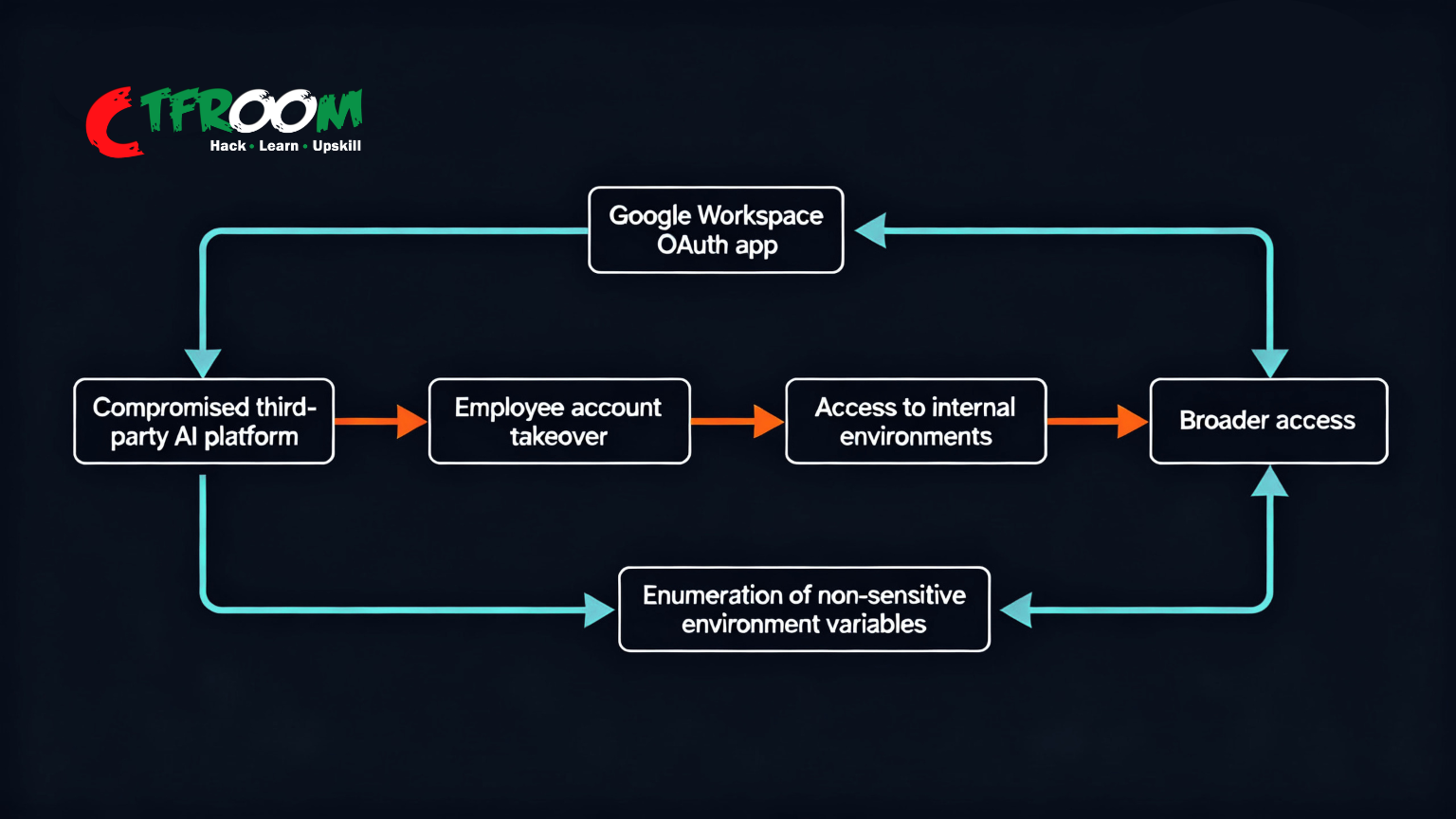
Based on Vercel’s bulletin and subsequent reporting, the sequence looks something like this: Context.ai was compromised, that compromise affected its Google Workspace OAuth app, an employee’s Vercel Google Workspace account was taken over through that path, and the attacker then pivoted into some Vercel environments and accessed environment variables that were not marked sensitive. BleepingComputer also reported statements from Vercel CEO Guillermo Rauch indicating that while “non-sensitive” variables were intended to hold lower-risk data, the attacker was able to gain further access through enumeration of those values.
That should make a lot of engineering and security teams slightly uncomfortable, for good reason.
Because “non-sensitive” is one of those labels that feels easy to overlook, right up until an attacker starts chaining what you considered harmless. A hostname here. A service identifier there. A token you thought was low impact. A reference string that points toward something more valuable. Individually, none of it looks catastrophic. Collectively, its Pandora’s box.
This is one of the oldest tricks in defensive self-deception. We imagine secrets only as the obviously shiny things: production database passwords, signing keys, master tokens. The attacker is usually less sentimental. They are perfectly happy to collect scraps, context, metadata, names, routing hints, deployment clues, and “harmless” variables if those scraps help them find the next foothold.
Which means the real lesson here is not merely “mark more secrets as sensitive,” though Vercel is absolutely right to tell customers to review and rotate environment variables and use the sensitive variable feature going forward. The deeper lesson is that exposure classification has to be based on attack paths, not on whether something feels less risky or boring to the person who named it.
Boring information is often just useful information clouded in humdrum.
The part every Google Workspace admin should read twice
Google Workspace already gives administrators a lot more control over third-party app access than many organizations actually use. Google’s admin guidance says apps can be set as Trusted, Specific Google data, Limited, or Blocked. It also says unconfigured third-party apps can be blocked by default, with user requests sent into Apps pending review for admin approval. Since late 2024, Google has also supported more granular control by allowing admins to configure third-party apps by specific API scopes, so apps do not silently gain broader access later without admin consent.
Simply put, you do not have to let every shiny new AI tool wander through your Workspace like it owns the place.
And yet many organizations still do.
Partly because the controls take effort. Partly because productivity tools always arrive with a plausible business case. Partly because security teams are tired and users are persistent and nobody wants to be remembered as the department that blocked “the note-taking assistant everyone loves.” Then one day the note-taking assistant, or research assistant, or CRM assistant, or whatever-assistant, ends up in the middle of a broader compromise and suddenly the phrase “business enablement” loses a little of its glow.
That is why the Vercel incident matters far beyond Vercel.
This was not just a cloud company having a bad Sunday. It was a live demonstration of how SaaS-to-SaaS trust can become breach infrastructure.